Creative digital teaching and learning for green air transport and logistics
Aviation news
The IATA Annual Review 2024 details the aviation industry’s strong recovery in 2023, alongside its significant challenges and strategic priorities. Financially, the industry returned to profitability, achieving an estimated $27.4 billion net profit after substantial pandemic-era losses. This was driven by a robust rebound in passenger traffic; domestic markets fully recovered, while long-haul markets largely completed their recovery. Despite this, net profit margins remain thin at 3.0%, and airlines continue to face frustrations from persistent supply chain issues and high costs.
Safety performance in 2023 was a major achievement, described as the “best-ever” by several key metrics. Notably, there were no fatal accidents involving IATA member airlines or any airline on the IATA Operational Safety Audit (IOSA) registry. The IOSA program, which marked its 20th year, remains a cornerstone of the industry’s safety strategy.
The industry’s foremost challenge and focus is achieving its commitment to net zero carbon emissions by 2050. Sustainable Aviation Fuels (SAF) are central to this goal, with IATA estimating they will provide 65% of the required carbon mitigation. However, the report highlights a critical bottleneck: insufficient production. In 2023, SAF accounted for just 0.2% of total fuel used. IATA urgently calls for government policies to incentivize a massive scale-up in SAF production and is establishing a SAF Registry to authoritatively account for and report emissions reductions.
Key strategic initiatives for modernization are also underway. The Modern Airline Retailing program aims to transform the customer experience by moving the industry from legacy e-tickets and PNRs to a more flexible system of “Offers and Orders”. This is complemented by the One ID initiative, which uses digital identity and biometrics to create a seamless, contactless passenger journey. The report also details advocacy efforts against unilateral regulatory actions, such as proposed capacity cuts at Schiphol Airport , and progress in diversity and inclusion through the 25by2025 initiative, which has seen an increase in female representation in senior roles.

https://www.iata.org/contentassets/c81222d96c9a4e0bb4ff6ced0126f0bb/iata-annual-review-2024.pdf
 Aviation is undergoing a change focused on digitalization and sustainability. The European Green Deal seeks to reduce emission levels from 1990 levels. This makes a change in all parts of the aviation industry necessary.
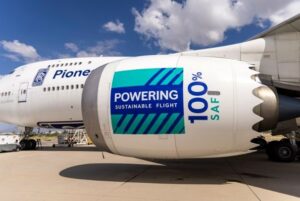
In recent months, great steps are being taken to achieve sustainability. Virgin Atlantic, with the help of Rolls Royce, is preparing the first trans-Atlantic flight using 100% sustainable fuel.
A SAF blend of 88% HEFA and 12% aromatics has already been ground tested for the Rolls Royce Trent 1000 engine. These tests have been satisfactory, and Virgin Atlantic airline is considering launching it on a flight from London-Heatrow to New York JFK. This flight will be carried out by a Boeing 787 Dreamliner on November 28, 2023. This flight will consume 60 tons of SAF, which will be supplied by the fuel supplier Air BP (via Sustainable Aviation, link: https://www.aviacionline.com/2023/08/virgin-atlantic-y-rolls-royce-preparan-el-primer-vuelo-transatlantico-con-100-combustible-sostenible/).
As you can see in this news, to achieve a milestone like the first sustainable transatlantic flight, collaboration between many stakeholders is needed. In AVIONIC Project, co-funded by the European Union, we have this clear, for this reason, we try to achieve a joint vision focused on sustainability and digitalization of aviation, through education. We believe that in order to achieve these advances, it is necessary for the aviation professionals of the future to have digital and green competencies, to be able to contribute to this change that the industry is undergoing. For this reason, we continue to work to adapt our courses to the green needs of the industry.
This decade is proving decisive for climate change, with Europe warming faster than any other continent. The European aviation sector, while strategically important, is at a crossroads in its decarbonisation transition. It faces increasing pressure to meet environmental goals amid challenges like supply chain issues (delaying fleet renewal) and the high cost and limited supply of Sustainable Aviation Fuel (SAF).
The report notes that in 2023, flights in the EU27+EFTA region were still 10% below pre-COVID 2019 levels. CO2 emissions in 2023 were 133 million tonnes, also 10% less than in 2019. However, 6% of flights (long-haul, >4,000 km) accounted for 46% of all CO2 emissions. On the positive side, fuel efficiency has continued to improve, reducing to 3.3 litres per 100 passenger-kilometres.
A significant focus is the non-CO2 climate impacts of aviation (e.g., NOx, contrails), which historically accounted for more than half of aviation’s net warming effect. However, the uncertainty of these effects is high. To address this, a new monitoring (MRV) framework for non-CO2 emissions began on January 1, 2025, to gather data and support robust decision-making.
Noise remains a major challenge. In 2023, 3.4 million people were exposed to significant aircraft noise (Lden 55 dB) at 98 major European airports. While fleet renewal is expected to reduce noise exposure, trends vary by airport, with about one-third seeing an increase in noise between 2019 and 2023.
Key strategic priorities and recommendations from the report include:
-
Sustainable Aviation Fuels (SAF): Scaling up SAF is critical. The ReFuelEU Aviation Regulation mandates a SAF supply starting at 2% in 2025 and rising to 70% in 2050. Meeting this mandate could cut net CO2 emissions by 47% in 2050. Key challenges remain the high price (3-10 times conventional fuel) and the need for a rapid expansion of production capacity.
-
Single European Sky (SES): Implementing reforms to modernise Air Traffic Management (ATM) is crucial to enhance efficiency and sustainability. Completing the SES ATM Master Plan vision could save 400 million tonnes of CO2 by 2050.
- Technology and Standards: The report calls for ambitious new CO2 and noise standards for aircraft in 2025 to drive innovation. It also recommends reviewing NOx emissions standards, which have grown faster than CO2.
- Market-Based Measures: The EU Emissions Trading System (ETS) is being strengthened by phasing out free allowances for airlines. Concurrently, the ICAO CORSIA offsetting scheme is expected to begin for 2024 emissions.
- Airport Actions: Airports are urged to invest in onsite renewable energy, electrify ground operations, and adapt infrastructure to support SAF and zero-emission aircraft.

Analysis from AviationValues reveals that older-generation aircraft, specifically the Airbus A320ceo and Boeing 737-800, still dominate the skies, making up 70% of the world’s narrowbody fleet as of March 2024. These two models alone account for 59% of the main single-aisle aircraft in service.
The Boeing 737-800 is the most common, with 4,696 aircraft, followed by the Airbus A320ceo, with 4,090. Despite long production runs, both have been superseded by their “new-generation” replacements, the Boeing 737 MAX and the Airbus A320neo family, respectively.
This 70/30 split between old and new technology highlights that airlines have a significant way to go in modernizing their fleets. The transition has been slowed by supply chain issues and Boeing’s specific production and certification challenges with the 737 MAX, which has allowed Airbus to deliver more new-generation aircraft.
This fleet replacement is a significant environmental concern. The newer aircraft offer substantial efficiency gains; both the A320neo and 737 MAX burn about 20% less fuel compared to their predecessors, which also reduces CO2 emissions and noise.

https://simpleflying.com/old-tech-boeing-737-airbus-a320-planes-70-percent-narrowbody-fleet/
The emerging “air taxi” industry, centered on electric vertical takeoff and landing (eVTOL) aircraft, could create a demand for up to 60,000 new pilots by 2028, according to a projection by McKinsey & Co. This new demand comes on top of the already significant need for commercial airline pilots, estimated by manufacturers like Boeing and Airbus to be in the hundreds of thousands over the next two decades.
A key point from the report is that while most eVTOL aircraft are designed for eventual autonomous flight, pilots will be essential for the industry’s “near-term” success. This is because gaining regulatory approval and public acceptance for fully autonomous passenger vehicles flying over cities could take a decade or more. In the meantime, the industry faces the challenge of recruiting and training thousands of pilots.
The article highlights the rapid development in the sector, with companies like Joby Aviation on track to launch services as early as 2025. Joby has already completed over 1,500 test flights and is expanding its manufacturing capacity. The UAE, particularly Dubai, is a key player, aiming to be the first city with a fully developed network of “vertiports” by 2026. This network, operated in partnership with Joby and Skyports, plans to offer flights connecting key locations like Dubai International Airport and the Palm Jumeirah in just 10 minutes, a journey that takes 45 minutes by car. The air taxi market is projected to grow significantly, from about $2.94 billion in 2022 to over $37 billion by 2032.

https://gulfnews.com/special-reports/60000-jobs-new-pilots-needed-to-fly-air-taxis-1.1716222080161
The report outlines a strong, albeit uneven, recovery for global air traffic following the COVID-19 pandemic, with significant long-term growth projected. Global passenger traffic was expected to reach 8.7 billion in 2023, representing 95% of 2019 levels. A major milestone is anticipated in 2024, with forecasts showing global passenger traffic reaching 9.7 billion, surpassing pre-pandemic (2019) levels for the first time.
The recovery in 2023 and 2024 is primarily driven by the international passenger market. Regionally, the recovery varies: Latin America-Caribbean, the Middle East, and North America were all expected to meet or exceed their 2019 passenger traffic levels in 2023. While the Asia-Pacific region saw the largest year-on-year growth, it lagged in overall recovery, largely because its major markets were among the last to lift travel restrictions.
Looking at the long-term, global passenger traffic is projected to grow at a compound annual growth rate (CAGR) of 4.3% between 2023 and 2042. This growth is expected to result in passenger numbers doubling from 2024 to 2042, reaching nearly 20 billion. By 2052, traffic is forecasted to be 2.5 times the 2024 level. This long-term trend highlights a significant shift from advanced economies towards emerging and developing economies, which are projected to have a much higher CAGR (5.4% vs. 3.2% for advanced economies). This will reshape the top 20 passenger markets, with countries in the Asia-Pacific region gaining prominence.
In contrast, the global air cargo market experienced a post-pandemic decline, dropping from its 2021 peak. After an expected 5% reduction in 2023, the market is forecasted to see a 6% rebound in 2024. The long-term outlook for cargo remains positive, though more moderate than passenger growth, with a projected CAGR of 3.3% from 2023 to 2042.

https://store.aci.aero/wp-content/uploads/2024/02/WATF-Executive-Summary.pdf